
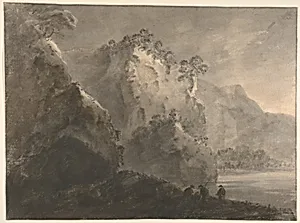
Landscape with Hills and a Lake
ca. 1772
Medium
Pen and black ink, brush and gray wash, on buff paper
Dimensions
Sheet: 10 13/16 × 14 7/16 in. (27.5 × 36.6 cm) (irregular)
Classification
Drawings
Department
Drawings and Prints
Museum
Metropolitan Museum of Art, New York, NY
Credit
Purchase, The Elisha Whittelsey Collection, The Elisha Whittelsey Fund, and Jeffrey L. Berenson Gift, 2012
Accession Number
2012.380
Rights
Public Domain
Tags
Art Historical Context
In the late 18th century, artist and writer William Gilpin captured the rugged beauty of nature in *Landscape with Hills and a* (ca. 1772), a delicate drawing that exemplifies the emerging Picturesque aesthetic. Gilpin, ayman and influential theorist, championed landscapes that evoked a sense of sublime irregularity—neither perfectly beautiful like classical gardens nor terrifyingly wild, but evocatively "picturesque" like scenes from old paintings. This work, with its rolling hills framing a tranquil lake, reflects his tours through Britain's countryside, where he sketched to illustrate his ideas in books like *Observations on the River Wye*. Rendered in pen and black ink with brush and gray wash on buff paper, the piece measures about 11 by 14 inches and showcases Gilpin's fluid technique. The gray wash adds atmospheric depth, suggesting misty distances and soft light, while the ink lines define contours with a spontaneous energy typical of on-site studies. Housed in the Metropolitan Museum of Art's Drawings and Prints department, it highlights how such sketches bridged topography and artistic theory, inspiring later Romantics like Turner. This modest yet evocative drawing invites visitors to appreciate the era's shift toward finding artistic inspiration in everyday scenery, reminding us of nature's quiet poetry.