
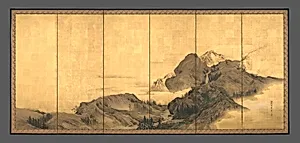
森周峰筆 楼閣山水図屏風|Landscape with Pavilion
early 19th century
Medium
Pair of six-panel folding screens; ink, color, gold flecks, and gold leaf on paper
Dimensions
Image (each screen): 5 ft. 2 3/16 in. x 11 ft. 8 15/16 in. (1.58 x 3.58 m)
Classification
Paintings
Culture & Period
Japan · Edo period (1615–1868)
Department
Asian Art
Museum
Metropolitan Museum of Art, New York, NY
Credit
Gift of Rosemarie and Leighton Longhi, 2001
Accession Number
2001.768.3, .4
Rights
Public Domain
Tags
Art Historical Context
**Landscape with Pavilion** by Mori Shūhō, a pair of lavish six-panel folding screens from 19th-century Japan, captures the serene beauty of Edo-period artistry (1615–1868). Crafted during a time of relative peace under the Tokugawa shunate, these screens reflect the era's fascination with idealized nature—towering mountains, misty waters, and elegant pavil—blending Japanese aesthetics with Chinese literati influences. Shūhō, a skilled painter of the time, evokes a harmonious world where architecture nestles poetically into the landscape, inviting contemplation. Rendered in ink, vibrant colors, gold flecks, and shimmering gold leaf on paper, the screens measure an impressive 5 feet high by nearly 12 feet wide each. This opulent medium was typical of high-end byōbu (folding screens), prized as room dividers and status symbols in elite homes or tea houses. The gold elements create a luminous, otherworldly glow, mimicking sunlight on water or clouds, a technique that enhances the painting's immersive depth and seasonal poetry. Housed in the Metropolitan Museum of Art's Asian Art collection (gift of Rosemarie and Leighton Longhi, 2001), this work exemplifies how Edo artists transformed everyday spaces into artistic sanctuaries, bridging the natural and the refined for generations of admirers.