
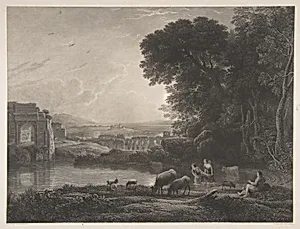
Landscape with Roman Ruins
Medium
Etching
Dimensions
sheet: 13 1/8 x 15 3/16 in. (33.4 x 38.5 cm)
Classification
Prints
Department
Drawings and Prints
Museum
Metropolitan Museum of Art, New York, NY
Credit
Harris Brisbane Dick Fund, 1947
Accession Number
47.100.818
Rights
Public Domain
Tags
Art Historical Context
Step into the sunlit serenity of *Landscape with Roman Ruins an exquisite etching after the 17th-century master Claude Lorrain (Claude Gellée), rendered by Scottish engraver William Miller around 1820–82. Lorrain, a pioneer of the classical landscape genre, captured the poetic harmony of ancient Roman ruins amid lush pastoral scenes—here evoking crumbling arches, graceful trees, wandering women, and grazing cows. This print, measuring 13 1/8 x 15 3/16 inches, preserves Lorrain's signature "Lorrain glass" effect: a luminous, atmospheric glow that bathes the composition in golden light, blending nostalgia for antiquity with the tranquility of nature. Etching, the medium's hallmark technique, involved Miller incising intricate lines into a metal plate with acid, allowing for delicate tonal gradations that mimic Lorrain's oil paintings. Produced in the early 19th century, this work reflects the Romantic era's fascination with ruins as symbols of time's passage and human impermanence, making high art accessible through prints. Acquired via the Harris Brisbane Dick Fund in 1947, it resides in the Metropolitan Museum of Art's Drawings and Prints department, inviting visitors to ponder the enduring allure of idealized Italianate vistas that inspired generations of landscape artists.
About the Artist
Claude Lorrain (Claude Gellée)|William Miller · 1604–1682
Claude Gellée was born around 1600 in the village of Chamagne in the Duchy of Lorraine, from which he would take the professional name by which history knows him: Claude Lorrain. Orphaned young, he traveled south to Rome as a teenager, eventually finding his way into the Naples workshop of Goffredo Wals before apprenticing with the Roman landscapist and fresco painter Agostino Tassi around 1622. F...