
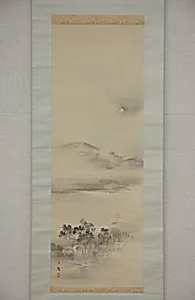
Landscape with the Moon
19th century
Medium
Hanging scroll; ink and color on silk
Dimensions
39 1/4 x 13 7/8 in. (99.7 x 35.2 cm)
Classification
Paintings
Culture
Japan
Department
Asian Art
Museum
Metropolitan Museum of Art, New York, NY
Credit
The Howard Mansfield Collection, Purchase, Rogers Fund, 1936
Accession Number
36.100.5
Rights
Public Domain
Tags
Art Historical Context
Shiokawa Bunrin's *Landscape with the Moon*19th century) captures the serene beauty of a moonlit night in Japan through the delicate medium of a hanging scrollink and color on silk Measuring 39¼ x 13⅞ inches, this vertical composition invites viewers to imagine towering mountains bathed in soft lunar glow, evoking the timeless harmony between nature and the cosmos. Bunrin, a master of the Nanga ( School) style, drew inspiration from Chinese literati painting, blending free-flowing ink washes with subtle colors to suggest mist-shrouded peaks rather than depict them with precise detail. Hanging scrolls like this were cherished in Japanese homes and temples, unrolled for contemplation during special occasions, reflecting Edo-period (and early Meiji) appreciation for poetic landscapes. Bunrin's technique—layered ink for depth and pale hues for ethereal light—highlights the medium's luminosity on silk, allowing the moon's glow to seem alive. Part of The Metropolitan Museum of Art's Asian Art collection (acquired via the Howard Mansfield Collection in 1936), it exemplifies how 19th-century Japanese artists bridged traditional ink painting with personal expression, offering visitors a window into Japan's romanticized natural world.