
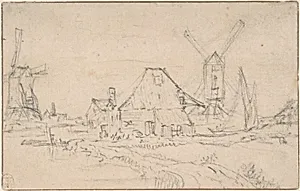
Landscape With Two Mills
17th century
Medium
Black chalk
Dimensions
sheet: 3 13/16 X 6 in. (9.7 x 15.3 cm)
Classification
Drawings
Department
Drawings and Prints
Museum
Metropolitan Museum of Art, New York, NY
Credit
Given in memory of Felix M. Warburg by his wife and children, 1941
Accession Number
41.21.1
Rights
Public Domain
Tags
Art Historical Context
Created in the 17 century during the Dutch Golden Age, Rembrandt van Rijn’s “Landscape With Two Mills” captures the quiet beauty of the Netherlands’ flat countryside. Rendered in black chalk on a modest sheet measuring just under four by six inches, this delicate drawing exemplifies Rembrandt’s masterful ability to suggest expansive space and atmospheric light with economical means. Windmills, iconic symbols of Dutch ingenuity and daily life, rise gently against the horizon, reflecting the period’s fascination with the natural world and human harmony with it. Though best known for his dramatic paintings and etchings, Rembrandt produced hundreds of drawings that reveal his keen observational skills. This work likely served as a personal study or travel sketch, demonstrating how he used subtle tonal variations in chalk to evoke depth and movement without color. Such intimate drawings offer modern viewers a rare glimpse into the artist’s process and the unassuming landscapes that inspired one of history’s greatest draftsmen. Donated to the Metropolitan Museum of Art in 1941 by the family of Felix M. Warburg, the piece remains a treasured example of Rembrandt’s versatility and the enduring appeal of Dutch landscape art.
About the Artist
Rembrandt (Rembrandt van Rijn) · 1606–1669
Rembrandt Harmenszoon van Rijn (1606–1669) stands as one of the greatest visual artists in the history of Western art and the most important Dutch painter of the 17th century. Born in Leiden to a prosperous miller's family, Rembrandt transformed painting through his revolutionary use of light and shadow, his psychological depth in portraiture, and his elevation of etching to a fine art. His approx...