
明 董其昌 山水圖 冊|Landscapes after old masters
dated 1630
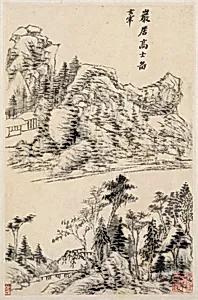
Medium
Album of eight leaves; ink on paper
Dimensions
Image (each): 9 5/8 x 6 5/16 in. (24.4 x 16 cm)
Classification
Paintings
Culture & Period
China · Ming dynasty (1368–1644)
Department
Asian Art
Museum
Metropolitan Museum of Art, New York, NY
Credit
Edward Elliott Family Collection, Gift of Douglas Dillon, 1986
Accession Number
1986.266.5a–k
Rights
Public Domain
Tags
Art Historical Context
Dong Qichang's *Landscapes after Old Masters* (1630) is a exquisite Ming dynasty album comprising eight leaves of ink on paper, measuring about 9⅝ × 6½ inches. Created late in the artist's life, this intimate format was ideal for scholar-artists like Dong, a high-ranking official and leading theorist who championed the expressive, individualistic "Southern school" of painting over more formulaic styles. By emulating revered predecessors, Dong demonstrated his mastery and reverence for China's painting tradition, blending subtle ink washes to evoke misty mountains and serene landscapes. As a pinnacle of literati painting (*wenrenhua*), the work reflects the Ming era's cultural zenith, where art served intellectual and spiritual pursuits amid political turmoil. Dong's technique—loose brushwork, layered textures, and empty spaces—captures the sublime harmony of nature, inviting viewers to contemplate the Daoist ideal of unity between man and cosmos. These small-scale scenes, tagged with motifs of mountains and landscapes, were treasured in private collections, underscoring the connoisseurship of elite Chinese society. Today, housed in the Metropolitan Museum of Art's Asian Art department (gift of the Edward Elliott Family Collection via Douglas Dillon, 1986), this album offers a window into Dong's profound influence on later generations, bridging classical heritage with personal innovation.
About the Artist
Dong Qichang · 1555–1636
Dong Qichang (1555–1636), born in Huating in present-day Shanghai's Songjiang region, emerged from a scholarly yet impoverished family as the son of a local school teacher. A precocious child, he passed the prefectural civil service examination at age twelve, securing entry to a government school, and later sat for the imperial exams, placing second at seventeen to his cousin due to inferior calli...