
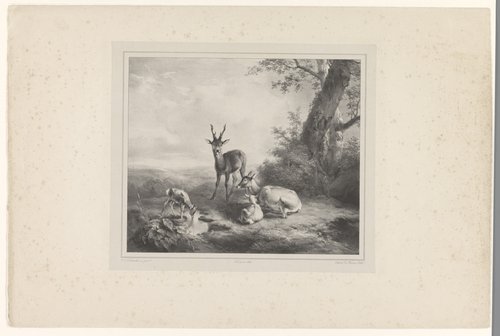
Landschap met herten
ca. 1835
Medium
lithography
Dimensions
556; 364
Rights
Public Domain
About this artwork
height 364 mm x width 556 mm
Art Historical Context
**Landschap met hertenLandscape with Deer)** Théodore Fourmo, ca. 1835, lithography, 364 × 556 mm* Théodore Fourmois a prominent Belgian landscape artist of the Romantic era (1814–1866), captures the serene beauty of nature inLandschap met h*, created around 1835. This lithograph depicts a tranquil scene likely featuring deer amid a expansive vista, evoking the Romantic ideal of harmony between humanity and the wild. Fourmois, often called the "Belgian Corot" for his luminous, detailed renditions of the countryside, drew inspiration from 17th-century Dutch and Flemish masters, blending realism with poetic atmosphere. Lithography, the medium here, was revolutionary in the 1830s—a chemical printing process invented decades earlier that allowed artists like Fourmois to produce affordable, high-quality reproductions. This technique enabled wider access to fine art during Belgium's early years of independence (post-1830), when national pride fueled interest in local landscapes. Measuring a generous 364 × 556 mm, the print's scale enhances its immersive quality, inviting viewers to wander its imagined paths. As one of Fourmois's early works, it showcases his emerging mastery of light and texture, foreshadowing his later oil paintings celebrated in Belgian museums. A charming window into 19th-century Romanticism, it reminds us how prints democratized art, bringing nature's quiet majesty into everyday homes.
About the Artist
Théodore Fourmois · 1814–1871
Théodore Fourmois (1814–1871) was a pioneering Belgian landscape painter and printmaker who played a crucial role in liberating Belgian art from academic conventions and establishing a distinctly Belgian tradition of plein air landscape painting. Born in Presles in 1814 and dying in Ixelles in 1871, Fourmois bridged the Romantic and Realist movements in Belgian art, combining emotional responsiven...