
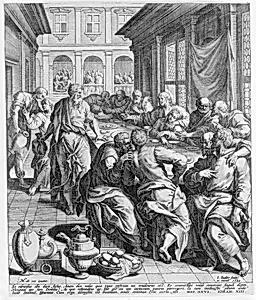
Last Supper from the Passion of Christ
Medium
Engraving
Dimensions
sheet: 9 7/16 x 7 7/8 in. (23.9 x 20 cm)
Classification
Prints
Department
Drawings and Prints
Museum
Metropolitan Museum of Art, New York, NY
Credit
The Elisha Whittelsey Collection, The Elisha Whittelsey Fund, 1951
Accession Number
51.501.1696(4)
Rights
Public Domain
Tags
Art Historical Context
This engraving, created in 1582 by Johann Sadeler I after a design by Maerten de Vos, captures the intimate yet solemn moment of the Last Supper. As part of a larger series on the Passion of Christ, the print portrays Jesus sharing the Passover meal with his Apostles in a detailed architectural setting. Sadeler, a skilled Flemish engraver, translated de Vos’s composition into fine lines and rich contrasts, allowing the emotional weight of the scene—betrayal foretold and fellowship shared—to emerge with clarity. Engravings like this played a vital role in the late sixteenth century, when printed images helped spread religious stories across Europe during the Counter-Reformation. The medium’s precision enabled wide distribution of devotional subjects, making sacred narratives accessible beyond church walls. Here, the carefully rendered buildings and figures reflect the Northern Renaissance interest in both spiritual meaning and realistic detail. Housed today in the Metropolitan Museum of Art’s collection of prints, this work exemplifies how collaborative partnerships between painters and engravers expanded the reach of religious art. Its modest size invites close looking, rewarding viewers with subtle expressions and symbolic elements that continue to resonate centuries later.
About the Artist
Johann Sadeler I|Maerten de Vos · 1550–1601
**Johann Sadeler I (also known as Jan or Johannes Sadeler), born in Brussels in 1550 and active until his death in Venice in 1600, stands as a pivotal figure in the Sadeler family, the most prolific dynasty of Flemish engravers and print publishers in Northern Europe during the late sixteenth and early seventeenth centuries.** As the eldest of three brothers—including Aegidius I and Raphael I—he ...