
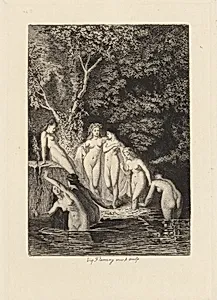
Le Bain, plate 6 from "The Decameron"
Medium
Etching; proof before letter
Dimensions
Sheet: 8 9/16 × 7 3/8 in. (21.7 × 18.8 cm)
Classification
Prints
Department
Drawings and Prints
Museum
Metropolitan Museum of Art, New York, NY
Credit
Harris Brisbane Dick Fund, 1917
Accession Number
17.3.3379–4
Rights
Public Domain
Art Historical Context
**Le Bain, plate 6 from "The Decon"** Léopold Flameng (, 1841–1911), 1873 Etching; proof before letter, Sheet: 8 9/16 × 7 3/8 in. (21.7 × 18.8 cm) The Metropolitan Museum of Art, Brisbane Dick Fund, 7 Step into the lively world of Giovanni Boccaccio's *The Decameron* (c. 1353), a masterful collection of 100 tales spun by ten young Florentines escaping the Black Death. In 1873, acclaimed French etcher Léopold Flameng captured the spirit of this Renaissance classic with *Le Bain* (The Bath), plate 6 from his celebrated series of illustrations. This intimate scene evokes the novella's playful, often sensual storytelling, blending humor, romance, and human folly amid medieval Italy's turmoil—a timeless reflection on love and survival. Flameng's etching exemplifies 19th-century virtuoso printmaking, where acid etches intricate lines into a metal plate for rich, tonal depth. As a "proof before letter," this rare early impression lacks publisher's text, prized by collectors for its pristine artistry. Working in a realist style, Flameng infused Boccaccio's narratives with elegant detail and subtle drama, bridging Renaissance literature with modern illustration techniques. Displayed in the Met's Drawings and Prints department, it highlights the enduring cultural allure of *The Decameron*, which inspired countless artists and remains a cornerstone of Western storytelling.
About the Artist
Léopold Flameng|Giovanni Boccaccio · 1831–1911
Léopold Flameng (1831–1911) was one of the most accomplished and influential French engravers of the 19th century, whose exceptional technical mastery and artistic sensitivity made him the preeminent interpreter of paintings by old and modern masters through the medium of engraving. Born in Brussels on November 22, 1831, to French parents, and dying at Courgent, near Paris, on September 5, 1911, F...