
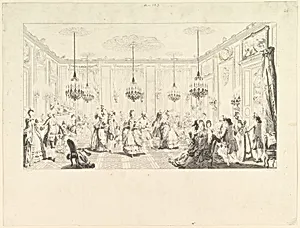
Le Bal Paré
Medium
Etched proof; first state of four (Bocher)
Dimensions
Sheet: 13 7/16 × 17 11/16 in. (34.2 × 44.9 cm)
Classification
Prints
Department
Drawings and Prints
Museum
Metropolitan Museum of Art, New York, NY
Credit
Samuel D. Lee Fund, 1940
Accession Number
40.34.1
Rights
Public Domain
Tags
Art Historical Context
**Le Bal Paré (The Fancy Ball), 1774** Step into the lavish whirl of 18th-century high society with *Le Bal Paré*, an etched proof by engraver Augustin de Saint-A after a design by painter Antoine Jean Duclos. first-state impression— one of four documented by scholar François Bocher—captures masquerade ball alive with elegantly dressed men and women mid-dance. Measuring 13 7/16 × 17 11/16 inches, the print's expansive sheet allows for a bustling scene of swirling skirts, powdered wigs, and animated figures, evoking the opulent soirées of pre-Revolutionary Paris or Versailles. Created in 1774, during the Rococo twilight under Louis XVI, the artwork reflects the era's fascination with pleasure and spectacle. Masquerade balls were social equalizers where nobility and bourgeoisie mingled in disguise, offering a glimpse into the fleeting extravagance before the French Revolution upended such indulgences. Duclos's painterly composition, masterfully translated by Saint-Aubin's etching, highlights the Rococo emphasis on graceful movement and decorative detail. Etching proofs like this were experimental stages, prized today for their raw, unfinished quality—often showing artist corrections before final publication. Housed in The Metropolitan Museum of Art's Drawings and Prints department (Samuel D. Lee Fund, 1940), *Le Bal Paré* invites us to savor a vanished world's rhythmic joy, a testament to printmaking's power to preserve ephemeral festivities. (198 words)
About the Artist
Augustin de Saint-Aubin|Antoine Jean Duclos · 1736–1807
Comment on works: Illustrator; Engraver