
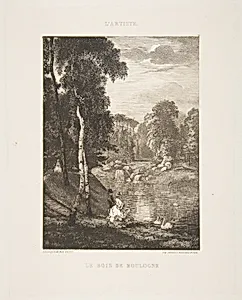
Le Bois de Boulogne, from "L'Artiste"
Medium
Etching; fifth state of five
Dimensions
Sheet: 12 5/16 × 8 15/16 in. (31.3 × 22.7 cm) Plate: 9 5/8 × 7 1/4 in. (24.5 × 18.4 cm)
Classification
Prints
Department
Drawings and Prints
Museum
Metropolitan Museum of Art, New York, NY
Credit
The Elisha Whittelsey Collection, The Elisha Whittelsey Fund, 1963
Accession Number
63.625.66
Rights
Public Domain
Tags
Art Historical Context
### Le Bois de Boulogne from *L'Artiste* Nestled in the heart of Paris, the Bois de Boulogne a beloved urban oasis during the mid-19th century, into a grand public park under Napoleon III. Félix Bracquemond 1857 etching captures its serene allure, depicting elegant men and women strolling amid lush trees, graceful swans gliding on waters, and birds in flight. Published in the influential art periodical *L'Artiste*, print reflects the era's fascination with leisurely outdoor scenes, blending Romantic naturalism with emerging modern sensibilities. Bracquemond, a pioneering French printmaker, was a leader in the Etching Revival, championing the medium's expressive potential over mechanical reproduction. As the fifth and final state of five, this etching showcases Bracquemond's meticulous refinement process—each state involving subtle reworking of the copper plate to enhance depth, texture, and atmosphere. Etching's aquatint-like tones evoke the dappled light filtering through leaves, inviting viewers to feel the park's tranquil rhythm. Printed by Imprimerie Sarazin, it exemplifies the technical virtuosity of 19th-century French printmaking, bridging fine art and accessible illustration. Today, housed in the Metropolitan Museum of Art's Drawings and Prints department (The Elisha Whittelsey Collection, 1963), *Le Bois de Boulogne* offers a window into Second Empire leisure culture, reminding us how art immortalizes everyday elegance. (198 words)
About the Artist
Imprimerie Sarazin|Félix Bracquemond (French|French) · |1833 – |1914
Paris, active 19th century|French, Paris 1833–1914 Sèvres