
Le bournous
1860s
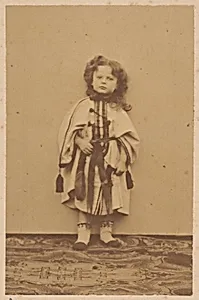
Medium
Albumen silver print from glass negative
Classification
Photographs
Department
Photographs
Museum
Metropolitan Museum of Art, New York, NY
Credit
David Hunter McAlpin Fund, 1975
Accession Number
1975.548.193.7
Rights
Public Domain
Tags
Art Historical Context
**Le Bournous**, a captivating albumen silver print from a negative by Pierre-Louis Pi, dates to the 1860s and captures the of a child's portrait. Pierson, a prominent French photographer associated with thedéri studio, specialized elegant studio portraits of high society, often featuring children in picturesque attire. The title refers to the *bournous*, a traditional North African hooded cloak, evoking the era's fascination with exotic costumes amid France's colonial interests in the Maghreb. This photograph exemplifies the albumen print process, the dominant medium of the mid-19th century, which combined egg whites with silver salts on paper to yield rich, warm tones and exquisite detail from sharp glass negatives. Such prints were prized for their clarity in cartes-de-visite and larger formats, making portraiture accessible to the bourgeoisie. Housed in The Metropolitan Museum of Art's Photographs Department (David Hunter McAlpin Fund, 1975), *Le Bournous* highlights 19th-century Orientalism in photography, blending European portrait conventions with cultural motifs. It offers a window into how children were idealized as innocent muses, dressed in "exotic" garb to delight Victorian audiences. A delightful blend of whimsy and technical mastery!
About the Artist
Pierre-Louis Pierson · 1822–1913
Pierre-Louis Pierson (1822–1913) was a pioneering French portrait photographer whose career spanned the formative years of the medium. Born on December 13, 1822, in Hinckange in the Moselle department, Pierson developed an early fascination with photography during the 1840s, as the daguerreotype was still in its infancy. His early life and formal training remain sparsely documented, but by 1844, h...