
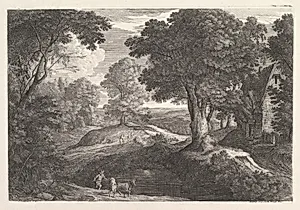
Le Bouvier pres d'une mare
Medium
Etching
Dimensions
plate: 11 5/8 x 18 1/8 in. (29.6 x 46 cm) image: 8 7/16 x 12 3/8 in. (21.4 x 31.5 cm)
Classification
Prints
Department
Drawings and Prints
Museum
Metropolitan Museum of Art, New York, NY
Credit
Harris Brisbane Dick Fund, 1945
Accession Number
45.35.16
Rights
Public Domain
Tags
Art Historical Context
**Le Bouvier près d'une mare (The Cowherd near a Pond)** This enchanting etching captures a tranquil pastoral scene, featuring a cowherd tending to cattle beside a shimmering pond, framed by expansive landscapes. Created by French etcher Jean Morin after a composition by Jacques Fouquières, both prominent 17th-century artists, the work evokes the idyllic rural life that captivated European viewers during the Baroque era. Though the exact date is unknown, it reflects the period's fascination with nature's harmony, blending human figures with animals in a serene, almost poetic setting—tags like "Men," "Cows," and "Landscapes" perfectly sum up its gentle charm. Etching, the medium here, was a revolutionary printmaking technique in Morin's time: an acid-resistant ground is scratched away on a copper plate, allowing acid to bite intricate lines for rich, tonal depth. Morin's skill shines in the delicate textures of foliage, rippling water, and animal forms, with the plate measuring 11⅝ × 18⅛ inches. Acquired through the Harris Brisbane Dick Fund in 1945, it's housed in the Metropolitan Museum of Art's Drawings and Prints department. This print not only preserved Fouquières' vision but also made such pastoral beauty accessible, highlighting etching's role in democratizing art during an age of artistic collaboration across France and Flanders. A timeless window into 17th-century countryside reverie! (198 words)
About the Artist
Jean Morin|Jacques Fouquieres · 1605–1650
Jean Morin (c. 1605–1650) was one of the most accomplished French engravers of the seventeenth century, a master of the portrait print whose work stands among the finest examples of French graphic art in its era. Little is known about his early life or training, though his technique suggests exposure to both French and Flemish engraving traditions, the latter being the dominant force in European p...