
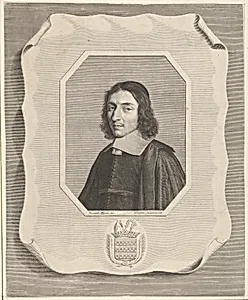
Le cardinal de Coislin
Medium
Engraving
Dimensions
Sheet: 11 × 9 1/16 in. (28 × 23 cm)
Classification
Prints
Department
Drawings and Prints
Museum
Metropolitan Museum of Art, New York, NY
Credit
Gift of Mr. Lev Tsitrin, 2001
Accession Number
2001.647.73
Rights
Public Domain
Tags
Art Historical Context
**Le Cardinal de Coislin** (1661) is a striking engraving portraying the French prelate Henri-Charles du Cambout Coislin, a prominent cardinal during the reign of Louis XIV. Created through a collaboration between designer Jean Lenfant and master engraver Robert Nante, this portrait exemplifies the opulent portraiture of 17th-century France Nanteuil, renowned as one of Europe's finest engravers, captured the cardinal's dignified presence with meticulous line work, emphasizing his ecclesiastical robes and the heraldic coat of arms that symbolized noble lineage and clerical authority. Engraving as a medium was revolutionary in this era, allowing high-quality reproductions of elite portraits to circulate widely among collectors and the aristocracy. Nanteuil's technique—employing fine burin strokes for texture and depth—brought a lifelike intensity to the sitter's gaze and attire, blending realism with the grandeur of Baroque portraiture. This print not only commemorates de Coislin's rise in the church hierarchy but also reflects the cultural prestige of such imagery in absolutist France. Today, housed in the Metropolitan Museum of Art's Drawings and Prints department (gift of Mr. Lev Tsitrin, 2001), it invites visitors to appreciate how 17th-century prints bridged art and status, making aristocratic splendor accessible beyond oil paintings. (198 words)