
Le chemise Russe
1860s
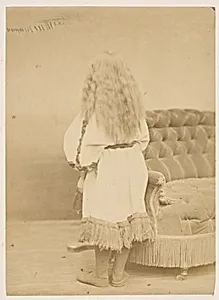
Medium
Albumen silver print from glass negative
Dimensions
8.6 x 12.1 cm. (3 3/8 x 4 3/4 in.)
Classification
Photographs
Department
Photographs
Museum
Metropolitan Museum of Art, New York, NY
Credit
David Hunter McAlpin Fund, 1975
Accession Number
1975.548.220
Rights
Public Domain
Tags
Art Historical Context
**Le Chemise Russe**, a charming albumen silver print by Pierre-Louis Pierson from 1860s, the innocence of childhood through a intimate portrait likely featuring a young subject dressed in a "Russian shirt"—a loose, comfortable garment inspired by Eastern European peasant styles that gained popularity in fashionable 19th-century Europe.erson, a prominent French photographer associated with thedéri studio, specialized cartes de visite, small photographic calling cards that revolutionized portraiture by making professional images affordable and shareable among the bourgeoisie. This 8.6 x 12.1 cm print, made from a glass negative, exemplifies the albumen process's technical brilliance: egg whites coated the paper for a glossy surface that yielded sharp details and warm tones, ideal for evoking tenderness in child portraits. During France's Second Empire, such photographs documented family life and emerging fashion trends, blending artistry with social documentation. Housed in the Metropolitan Museum of Art's Photographs department (David Hunter McAlpin Fund, 1975), *Le Chemise Russe* highlights photography's shift from novelty to cultural staple, preserving fleeting moments of youth amid rapid industrialization. A delightful glimpse into Victorian-era whimsy! (198 words)
About the Artist
Pierre-Louis Pierson · 1822–1913
Pierre-Louis Pierson (1822–1913) was a pioneering French portrait photographer whose career spanned the formative years of the medium. Born on December 13, 1822, in Hinckange in the Moselle department, Pierson developed an early fascination with photography during the 1840s, as the daguerreotype was still in its infancy. His early life and formal training remain sparsely documented, but by 1844, h...