
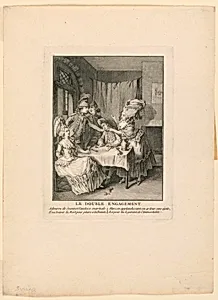
Le Double Engagement
ca. 1775-1780
Medium
Classification
Department
Smithsonian Collection
Museum
Smithsonian American Art Museum
Credit
Gift of Anonymous Donor
Accession Number
1957-61-37
Rights
Public Domain
About this artwork
Research in Progress
Art Historical Context
Claude-Louis Desrais created *Le Double Engagement* around 1775–1780, during a vibrant period of French printmaking that bridged the Rococo elegance of the mid-eighteenth century and the emerging Neoclassical tastes. As a French artist active in the decades before the Revolution, Desrais contributed to a flourishing culture of graphic art that circulated ideas, fashions, and social commentary across Europe. The title, translating to “The Double Engagement,” hints at a narrative scene likely exploring themes of commitment, perhaps romantic or social, that would have resonated with contemporary audiences. Prints like this one played a vital role in eighteenth-century visual culture, allowing artists to reach wider viewers than paintings alone could. Produced through techniques such as etching or engraving, they combined fine detail with reproducibility, making art more accessible while showcasing the artist’s skill in line and composition. Though research on this particular work remains in progress, its presence in the Smithsonian American Art Museum highlights the institution’s commitment to preserving international works that enrich our understanding of transatlantic artistic exchange. Acquired through the generosity of an anonymous donor, *Le Double Engagement* invites visitors to appreciate the quiet power of prints in telling stories from another era. Its delicate lines and evocative subject continue to spark curiosity about the social worlds Desrais observed and depicted.