
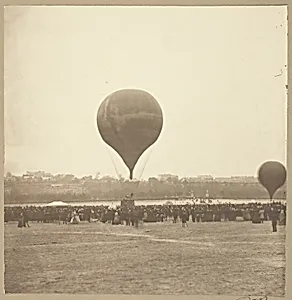
Le Geant, Champ de Mars
October 18, 1863, probably printed 1880/89
Medium
Gelatin silver printing out paper print
Dimensions
Image/paper: 17.1 × 16.5 cm (6 3/4 × 6 1/2 in.); First mount: 18.8 × 18.4 cm (7 7/16 × 7 1/4 in.); Second mount: 33 × 24.2 cm (13 × 9 9/16 in.)
Classification
gelatin silver printing-out-paper print
Department
Photography and Media
Museum
Art Institute of Chicago
Accession Number
92202
Rights
Public Domain
About this artwork
During the reign of Napoleon III (1852–70), Nadar cultivated an illustrious career as a writer, caricaturist, and, most notably, photographer, producing arresting portraits of his renowned friends and contemporaries. He was also an enthusiastic balloonist, an obsession that led him to construct the largest hot air balloon the world had seen and make the first aerial photographs in 1858. Viewing the Earth's surface from above, he wrote, "reduces all things to their relative proportions—to the Tru...
Art Historical Context
Step into the thrilling world of 19th innovation with *Le Géant, Champ de Mars by Nadar (Gaspard-Félix Tournachon), a pioneering French photographer, caricaturist, and aeronaut captured here on October 18, 1863. This gelatin silver printing-out-paper print likely made between 1880 and 1889, depicts Nadar's monumental hydrogen balloon, *Le Géant*—the largest of its time at over 60 meters tall—poised at Paris's Champ de Mars. Nadar, a restless visionary, launched it as a spectacle to advance aerial photography and scientific observation, drawing massive crowds eager for the dawn of flight. The image's historical significance lies in its snapshot of human ambition during the Second Empire era, when balloons symbolized progress amid industrialization. Nadar's ventures, including *Le Géant*'s dramatic flights (one infamously ending in a crash-landing), pushed photography's boundaries, blending documentary realism with adventure. As a master of portraiture and early aerial shots, Nadar elevated photography from mere record-keeping to an art form celebrating modernity. Printed decades later on gelatin silver paper—which allowed for rich tonal depth and detail through direct light exposure—this 17.1 × 16.5 cm image preserves the balloon's awe-inspiring scale against the Parisian skyline. A gem in the Art Institute of Chicago's Photography and Media collection, it invites us to marvel at the dreams that lifted humanity skyward.