
Le Grand Pénitencier
n.d.
Medium
Black chalk, pen and gray wash
Dimensions
4 13/16 x 7 in. (12.2 x 17.8 cm.)
Classification
Drawings
Department
Drawings and Prints
Museum
Metropolitan Museum of Art, New York, NY
Credit
Purchase, Sally Sample Aall, Anne and Jean Bonna, Sarah and Werner H. Kramarsky, and Adriana Mnuchin Foundation Gifts, and Van Day Truex Fund, 1996
Accession Number
1996.24
Rights
Public Domain
Tags
Art Historical Context
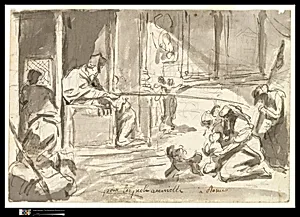
Augustin Pajou’s *Le Grand Pénitencier* offers a compact yet evocative glimpse into an eighteenth-century prison interior. Rendered in black chalk with pen and gray wash on a sheet just under five by seven inches, the drawing depicts men and women confined within a stark architectural setting. Pajou, best known as a leading French neoclassical sculptor, here turns his attention to the human figure and spatial drama, using fluid lines and subtle washes to convey both the weight of stone walls and the varied postures of the inmates. The choice of medium is particularly effective for such a subject. Black chalk provides soft tonal modeling of bodies and architecture, while the pen and gray wash add crisp definition and atmospheric depth, allowing Pajou to suggest dim light filtering into the space. Though undated, the work reflects the period’s growing interest in penal institutions and social reform, themes that resonated with Enlightenment audiences concerned with justice and humanity. Acquired by the Metropolitan Museum in 1996 through several generous gifts, this intimate drawing reveals Pajou’s skill in capturing narrative tension within a small format. It invites viewers to consider both the artist’s technical mastery and the broader cultural fascination with the prison as a site of moral and physical confinement.
About the Artist
Augustin Pajou · 1730–1809
Augustin Pajou (1730–1809) was one of the foremost French sculptors of the second half of the eighteenth century, whose long and distinguished career bridged the Rococo grace of the Ancien Régime and the more sober classicizing spirit that emerged in the revolutionary and Napoleonic periods. Born in Paris into a family with artistic connections — his father was an ornamental sculptor — Pajou showe...