
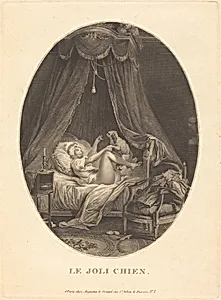
Le joli chien
Medium
stipple, etching, and engraving
Classification
Department
CG-E
Museum
National Gallery of Art, Washington, D.C.
Credit
Widener Collection
Accession Number
1942.9.2415
Rights
Public Domain
Art Historical Context
**Le Joli Chien** (*The Pretty Dog*), created between 1751 and 1775 by Auguste-Claude-S Legrand after Nicolas Lavince, captures the charm of 18th-century printmaking. This delightful work, housed in the National Gallery of's Widener Collection (Department CG-E), depicts a lovable canine subject, reflecting the era's fondness for whimsical animal portraits amid the ornate Rococo style. Lavreince, known for his lively animal scenes, provided the original design, while Legrand faithfully reproduced it as a print, a common practice to make art accessible to a wider audience beyond paintings. The medium—stipple, etching, and engraving—showcases innovative techniques of the time. Etching uses acid to bite lines into a metal plate for fluid strokes, engraving employs a burin for precise incisions, and stipple adds tonal depth through meticulously dotted patterns. Together, they produce soft, painterly effects ideal for rendering fur textures and expressive features, highlighting printmaking's rise as a democratic art form during the Enlightenment. This piece offers a window into pre-Revolutionary France, where playful motifs like elegant pets symbolized leisure and refinement among the elite. As a classified print, it exemplifies how reproductive techniques preserved and popularized imagery, inviting visitors to appreciate the artistry in everyday subjects.