
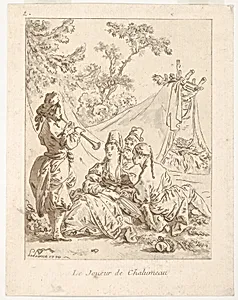
Le Joueur de Chalumeau
Medium
Aquatint
Dimensions
sheet: 6 1/16 x 4 3/4 in. (15.4 x 12 cm)
Classification
Prints
Department
Drawings and Prints
Museum
Metropolitan Museum of Art, New York, NY
Credit
Bequest of Phyllis Massar, 2011
Accession Number
2012.136.227
Rights
Public Domain
Tags
Art Historical Context
**Le Joueur de Chalumeau (The Shawm Player)**, created by French artist Jean-Baptiste Le Prince 1770, captures a lively moment of folk music-making. Le Prince, renowned for his scenes inspired by his travels in Russia during the 175s and 1760s, depicts a musician playing the chalumeau—a double-reed woodwind instrument to the shawm—surrounded by men and women with horns suggesting a rustic ensemble. This intimate aquatint print, measuring just 6 1/16 x 4 3/4 inches, reflects the 18th-century European fascination with exotic cultures and everyday peasant life. Printed in aquatint, a revolutionary intaglio technique Le Prince helped popularize in France around 1769, the work achieves soft, painterly tones resembling watercolor washes. This innovation allowed for nuanced shading and atmospheric depth, distinguishing it from crisper etchings and making it ideal for evoking the warmth of folk gatherings. Housed in The Metropolitan Museum of Art's Drawings and Prints department through the 2011 bequest of Phyllis Massar, this piece highlights Le Prince's role in bridging French Rococo elegance with Slavic traditions, offering visitors a window into Enlightenment-era curiosity about the "other." Imagine the reed's reedy wail piercing a village festival—timeless music frozen in ink.
About the Artist
Jean-Baptiste Le Prince · 1734–1781
Comment on works: Genre; Landscapes; Portraits; Copper engraver; Illustrator; Master draughtsman