
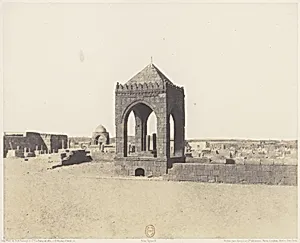
Le Kaire, Cimetière des Mamelouks
1851–52, printed 1853–54
Medium
Salted paper print from paper negative
Dimensions
24.0 x 30.0 cm. (9 7/16 x 11 13/16 in.)
Classification
Photographs
Department
Photographs
Museum
Metropolitan Museum of Art, New York, NY
Credit
Purchase, Lila Acheson Wallace Gift, 1976
Accession Number
1976.607.7
Rights
Public Domain
Tags
Art Historical Context
Step into the sun-drenched sands of 19th-century Egypt with Félix Teynard's *Le Kaire, Cimet des Mamelouks* (1851–52, printed 1853–), a salted paper print from a paper measuring 24 x 30 cm. Captured in Cairo's historic Mamluk Cemetery, this poignant photograph immortalizes the intricate tombs and minarets of the Mamlukselite warrior-rulers who governed Egypt from the 13th to 16th centuries. Teynard, a pioneering French photographer, ventured along the Nile during a golden age of exploration, blending scientific documentation with artistic vision. The salted paper process, an early calotype technique, yields the image's signature soft tones and subtle textures, evoking the hazy atmosphere of desert light. Printed by Imprimerie Photographique de H. de Fonteny et Cie, it exemplifies mid-19th-century photography's role in preserving vanishing architectural wonders amid Egyptomania—a European fascination with the Orient fueled by Napoleon's earlier campaigns. Today, housed in The Metropolitan Museum of Art (purchase, Lila Acheson Wallace Gift, 1976), this work bridges history and innovation. It invites us to ponder the Mamluks' legacy of opulent stonework, now silent guardians in Cairo's sprawling necropolis, reminding visitors of photography's power to transport us across time and cultures.
About the Artist
Félix Teynard|Imprimerie Photographique de H. de Fonteny et Cie · 1817–1892
**Félix Teynard (1817–1892)** was a pioneering French photographer whose work captured the ancient wonders of Egypt and Nubia with unprecedented precision and artistry. Born on January 14, 1817, in Saint-Flour, he trained as a civil engineer in Grenoble, a hub of Egyptology that likely sparked his fascination with ancient architecture. Little is documented about his early life or formal photograph...