
Le malingre cryptogame (The Sickly Cryptogam)
1860
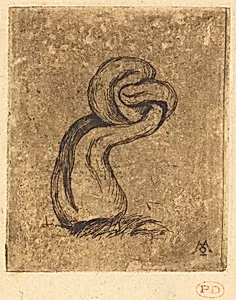
Medium
etching on laid paper
Dimensions
plate: 7.1 × 5.9 cm (2 13/16 × 2 5/16 in.) sheet: 14.1 × 12.2 cm (5 9/16 × 4 13/16 in.)
Classification
Department
CG-E
Museum
National Gallery of Art, Washington, D.C.
Credit
Rosenwald Collection
Accession Number
1943.3.6152
Rights
Public Domain
Art Historical Context
Charles Meryon, a pioneering French etcher of the mid-19th century (1–1868), is celebrated for his hauntingly precise views of Paris, blending Romantic realism with emerging Symbolist tendencies. Created in 1860, *Le malingre cryptame (The Sicklyogam)* marks a departure from his famed urban landscapes, evoking a fragile, otherworldly botanical subject—a "cryptogam" referring to non-flowering plants ferns or mosses, sickly or puny ("maling"). This intimate etching, with its diminutive plate size of just 7.1 × 5.9 cm, invites close contemplation, hinting at Meryon's personal struggles with mental illness during this period. Etched on laid paper—a traditional support with visible chain lines that enhances the tactile quality of prints—Meryon's technique showcases his virtuosity. He meticulously incised copper plates with acid, achieving extraordinary detail and atmospheric depth in tiny formats. This work exemplifies the 19th-century etching revival, where artists like Meryon elevated printmaking to fine art, rivaling painting in expressiveness. Housed in the National Gallery of Art's Rosenwald Collection, *Le malingre cryptogame* offers a poignant glimpse into Meryon's introspective later style, bridging documentary precision with poetic melancholy. Visitors are drawn to its subtle textures, a testament to how small-scale prints can capture profound vulnerability.
About the Artist
Charles Meryon · 1821–1868
Charles Meryon, born on November 23, 1821, in Paris, was the illegitimate son of English physician Dr. Charles Lewis Meryon and dancer Pierre-Narcisse Chaspoux (stage name Narcisse Gentil) at the Paris Opéra. His half-sister Fanny, from his mother's prior relationship with Viscount Lowther, remained in contact after their mother's death in 1838. Raised partly outside Paris before attending Pension...