
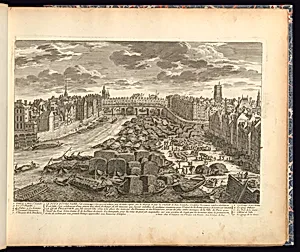
LE PONT NÔTRE DAME
late 17th century
Classification
Department
Smithsonian Collection
Museum
Smithsonian American Art Museum
Credit
Purchased for the Museum by the Advisory Council
Accession Number
1921-6-533-31
Rights
Public Domain
About this artwork
Research in Progress
Art Historical Context
Step into 17th-century Paris withLe Pont Notre-Dame*, a captivating by French artist Gabriel Per (1604–1677). Created in the late 1600s, this work captures the bustling Notre-Dame Bridge, a vital artery over the Seine lined with multi-story houses and shops—a hallmark of the city's vibrant medieval-to-Baroque urban life. During Louis XIV's reign, scenes reflected France's growing fascination with topographic accuracy, blending everyday energy with architectural grandeur. Perelle, a master engraver renowned for his intricate views of French landscapes and landmarks, likely employed etching techniques to render fine details of the bridge's arches, facades, and river traffic. Prints like this were revolutionary, making grand vistas accessible beyond elite circles and preserving fleeting urban moments before the bridge's 18th-century reconstruction. As a print, it exemplifies the era's printmaking boom, where copper plates allowed precise, reproducible art for collectors and travelers. Housed in the Smithsonian American Art Museum's collection—purchased by the Advisory Council—this piece invites us to ponder Paris's evolution. Though research continues, *Le Pont Notre-Dame* stands as a window into Perelle's meticulous style and the cultural pulse of ancien régime France.