
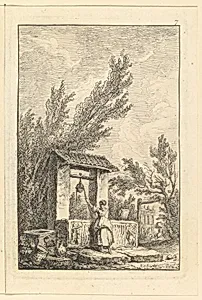
Le Puits
n.d.
Medium
Etching
Dimensions
sheet: 5 7/8 x 4 in. (15 x 10.2 cm) plate: 5 5/16 x 3 9/16 in. (13.5 x 9.1 cm)
Classification
Prints
Department
Drawings and Prints
Museum
Metropolitan Museum of Art, New York, NY
Credit
Harris Brisbane Dick Fund, 1929
Accession Number
29.55.7
Rights
Public Domain
Tags
Art Historical Context
Hubert Robert, the 18th-century French artist known as "Robert des Ruines," masterfully captured the romance of antiquity in his works, often blending real and imagined architecture with everyday life. *Le Puits* (The Well), an undated etching from the collection of the Metropolitan Museum of, exemplifies his printmaking prowess. Measuring just over 5 by 4 inches on the sheet, this intimate plate invites viewers into a serene, evocative scene likely featuring women gathered at a rustic well—a motif symbolizing communal life and pastoral tranquility in neoclassical art. Etching allowed Robert to achieve fine, intricate lines that mimic the textures of stone and foliage, a technique he honed after studying in Rome and absorbing influences from Giovanni Battista Piranesi's dramatic vedute. Produced via acid biting into a metal plate, the medium democratized his grand visions, making them accessible beyond oil paintings. Acquired through the Harris Brisbane Dick Fund in 1929, this print reflects Robert's fascination with ruins and human scale, evoking 18th-century nostalgia for a vanishing classical world. For visitors, *Le Puits* offers a window into how Robert infused everyday moments with timeless beauty, bridging the grandeur of ruins with intimate human stories—a hallmark of his enduring legacy in Drawings and Prints.
About the Artist
Hubert Robert · 1733–1808
Hubert Robert, born on May 22, 1733, in Paris, emerged from a modest background; his father, Nicolas Robert, served the influential Choiseul family, whose patronage shaped the young artist's path. After completing his studies at the Jesuit Collège de Navarre in 1751, he entered the atelier of sculptor Michel-Ange Slodtz, who taught him design and perspective before encouraging a shift to painting....