
Le regard
1860s
Medium
Albumen silver print from glass negative
Dimensions
8.6 x 12.1 cm. (3 3/8 x 4 3/4 in.)
Classification
Photographs
Department
Photographs
Museum
Metropolitan Museum of Art, New York, NY
Credit
David Hunter McAlpin Fund, 1975
Accession Number
1975.548.25
Rights
Public Domain
Tags
Art Historical Context
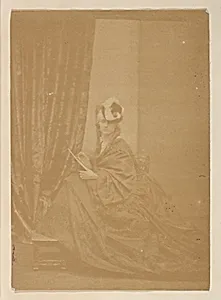
**Le regard (The Gaze)** Pierre-Louis Pierson's *Le regard*, created in the 1860s, is a striking albumen silver print from a negative, measuring a intimate 8.6 x 12.1 cm. This small-scale portrait exemplifies the elegance of mid-19th-century photography, capturing a woman's direct, piercing gaze that draws viewers into a moment of quiet intensity. Housed in the Metropolitan Museum of Art's Photographs Department (David Hunter McAlpin Fund 1975), it to a tradition of refined female portraits that highlighted poise and personality. The albumen process, using egg whites to bind light-sensitive silver salts to paper, produced the era's most detailed and richly toned images—sharp enough to rival paintings. Pierson, a master of the Mayer & Pierson studio in Paris, specialized in such high-society portraits during France's Second Empire, a time when photography blossomed as both art and status symbol. These works often immortalized the glamour of elite women amid Haussmann's modernizing city. *Le regard* reflects photography's cultural shift from novelty to artistic medium, inviting us to ponder the subject's unspoken story through her unflinching eyes—a timeless testament to 19th-century portraiture's psychological depth.
About the Artist
Pierre-Louis Pierson · 1822–1913
Pierre-Louis Pierson (1822–1913) was a pioneering French portrait photographer whose career spanned the formative years of the medium. Born on December 13, 1822, in Hinckange in the Moselle department, Pierson developed an early fascination with photography during the 1840s, as the daguerreotype was still in its infancy. His early life and formal training remain sparsely documented, but by 1844, h...