
Le Sourire
1899
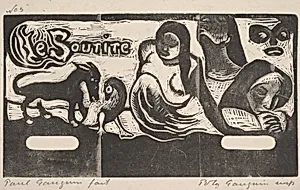
Medium
Woodcut on china paper
Dimensions
block: 4 x 7 1/4 in. (10.2 x 18.4 cm) sheet: 10 3/4 x 16 5/8 in. (27.3 x 42.2 cm)
Classification
Prints
Department
Drawings and Prints
Museum
Metropolitan Museum of Art, New York, NY
Credit
Rogers Fund, 1921
Accession Number
21.38.5
Rights
Public Domain
Tags
Art Historical Context
**Le Sourire (The Smile), 1899** Paul Gauguin's *Le Sourire* captures the artist's fascination with Polynesian life during his second stay in Tahiti. Created in 1899, this woodcut reflects Gauguin's Post-Impressionist shift toward Primitivism, where he sought inspiration from non-Western cultures to escape European conventions. The intimate scene likely features a smiling woman alongside birds—evoked by the tags of women, animals, and birds—symbolizing harmony with nature and exotic allure, themes central to his Noa Noa series of prints made from carved wooden blocks using local materials. Printed on delicate china paper, the work showcases Gauguin's innovative woodcut technique: rough, hand-carved lines produce bold contrasts and a raw, tactile quality, contrasting the finesse of traditional European engraving. At just 4 x 7¼ inches on the block, its small scale made it accessible, allowing Gauguin to disseminate his visionary ideas affordably amid financial struggles. Acquired by The Metropolitan Museum of Art via the Rogers Fund in 1921, *Le Sourire* exemplifies Gauguin's printmaking legacy, bridging fine art and folk traditions. Visitors will appreciate its joyful simplicity, a window into the artist's quest for paradise.
About the Artist
Paul Gauguin · 1848–1903
Paul Gauguin (1848-1903) was a French Post-Impressionist painter whose bold experiments with color, form, and subject matter made him one of the most influential figures in the transition from 19th-century art to modernism. His rejection of European civilization for the perceived authenticity of 'primitive' cultures established an archetype of artistic exile that continues to resonate. Gauguin's ...