
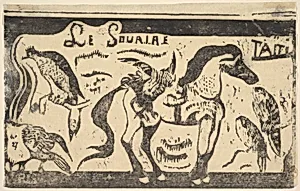
Le Sourire;Taiti (Smile; Tahiti)
December 1899
Medium
woodcut on transparent laid tissue paper
Dimensions
5 3/8 x 8 9/16 in. (13.7 x 21.8 cm): trimmed to image
Classification
Prints
Department
Drawings and Prints
Museum
Metropolitan Museum of Art, New York, NY
Credit
Harris Brisbane Dick Fund, 1936
Accession Number
36.11.9
Rights
Public Domain
Tags
Art Historical Context
In the waning months of 1899, Paul Gauguin, the pioneering Post-Impressionist, created *Le Sourire; Tahiti (Smile; Tah)* during his second sojourn in French Polynesia. Deeply immersed in Tahitian culture, Gauguin sought capture the island's exotic beauty and spiritual essence, fleeing the constraints of European society. This intimate woodcut, trimmed to its image at just 5 3/8 x 8 9/16 inches, evokes a serene yet enigmatic scene likely featuring birds and horses amid lush surroundings, with a titular "smile" hinting at joyful or mystical native life. Gauguin's mastery shines in his self-carved woodblock technique, printed on delicate, transparent laid tissue paper—a bold choice that lends a luminous, ethereal quality, as if the artwork glows with tropical light. Part of his experimental *Noa Noa* print series, it reflects his primitivist style: stark contours, flattened forms, and symbolic motifs that blend observation with imagination. These affordable prints sustained him financially when painting supplies ran scarce. Housed in the Metropolitan Museum of Art's Drawings and Prints department (Harris Brisbane Dick Fund, 1936), this rarity showcases Gauguin's innovative fusion of Western printmaking and Oceanic inspiration, bridging art worlds and forever romanticizing Tahiti for global audiences.
About the Artist
Paul Gauguin · 1848–1903
Paul Gauguin (1848-1903) was a French Post-Impressionist painter whose bold experiments with color, form, and subject matter made him one of the most influential figures in the transition from 19th-century art to modernism. His rejection of European civilization for the perceived authenticity of 'primitive' cultures established an archetype of artistic exile that continues to resonate. Gauguin's ...