
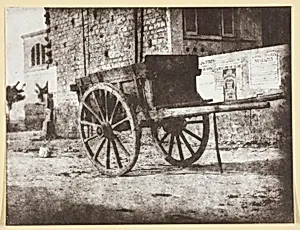
Le Tombereau
1842/50, printed 1965
Medium
Gelatin silver print, No. 11 from the portfolio "Bayard: XXV Calotypes, 1842-1850" (1965)
Dimensions
Image/paper/mount: 16.7 × 22.1 cm (6 5/8 × 8 3/4 in.)
Classification
photographic process
Department
Photography and Media
Museum
Art Institute of Chicago
Accession Number
23778
Rights
Public Domain
Art Historical Context
**Le Tombereau** by Hippolyte Bayard captures humble rural scene from mid-19th-century France likely featuring a dung cart a everyday landscape. Created as a calotype negative between 1842 and1850, this image exemplifies Bayard's pioneering work in early photography. A contemporary of Louis Daguerre and William Henry Fox Talbot, Bay independently invented a direct positive process in 1839, but his calotypes—using paper negatives sensitized with silver iodide—allowed for richer tones and the potential for multiple prints, revolutionizing the medium beyond the unique images of daguerreotypes. This particular print, made in 1965 as a gelatin silver print (No. 11 from the portfolio *Bayard: XXV Calotypes, 1842-1850*), preserves the subtle textures and atmospheric depth of Bayard's originals. Gelatin silver, a 20th-century process, offers crisp detail and permanence, making these early experiments accessible today. Measuring just 16.7 × 22.1 cm, it invites close viewing of the soft focus and painterly quality inherent to calotypes, blending photography's documentary precision with artistic interpretation. Bayard's work, housed in the Art Institute of Chicago's Photography and Media department, highlights photography's shift from scientific novelty to fine art. *Le Tombereau* reminds us of his overlooked legacy, documenting ordinary life with poetic sensitivity amid the era's technological fervor.
About the Artist
Hippolyte Bayard · 1801–1887
Hippolyte Bayard (1801–1887) was a French civil servant and artist who holds a remarkable, if bittersweet, place in the history of photography: he was one of the independent inventors of the photographic process in the late 1830s, developing his own direct positive paper print method at virtually the same moment that Louis Daguerre and William Henry Fox Talbot were arriving at their own solutions ...