
Le Triomphe de Voltaire
1778/79
Medium
Etching on ivory laid paper
Dimensions
Image: 39.8 × 58.8 cm (15 11/16 × 23 3/16 in.); Image with text and vignette: 49.7 × 60.4 cm (19 5/8 × 23 13/16 in.); Plate: 50.8 × 60.9 cm (20 × 24 in.); Sheet: 59.5 × 87.2 cm (23 7/16 × 34 3/8 in.)
Classification
etching
Department
Prints and Drawings
Museum
Art Institute of Chicago
Accession Number
148554
Rights
Public Domain
About this artwork
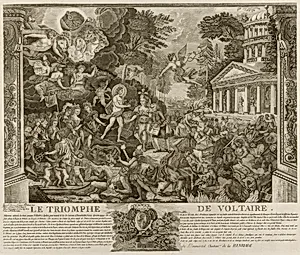
The French philosopher, playwright, and satirist Voltaire frequently deployed allegories touching on antiquity in his writings In this epic print, Melpomene, Muse of tragedy, leads Voltaire to Apollo to receive the crown of immortality, while his detractors face the fiery pit of hell and Thalia, Muse of comedy, doubles over in laughter. In the background a sculpted bust of Voltaire is wreathed, a ceremony enacted on Paris stages after the writer’s 1778 death. The print was likely made around 179...
Art Historical Context
Created in 1778/79, shortly after Voltaire’s death, *Le Triomphe de Voltaire* celebrates the French philosopher’s enduring legacy during the height of the Enlightenment. The title, meaning “The Triumph of Voltaire,” suggests an allegorical scene honoring his literary achievements, wit, and defense of reason. As a print issued in multiple impressions, the work allowed viewers across Europe to participate in the public veneration of one of the era’s most influential thinkers. Executed as an etching on ivory laid paper, the medium was ideally suited for capturing fine detail while enabling wide circulation. Etchings like this one combined text, vignette, and large-scale imagery—here measuring nearly 50 by 60 centimeters within the plate—to function both as art and as a commemorative document. Such prints played a vital role in shaping public memory, transforming Voltaire’s image into a symbol of intellectual freedom. Now preserved in the Art Institute of Chicago’s department of Prints and Drawings, the sheet exemplifies how eighteenth-century graphic media bridged private appreciation and collective cultural celebration.