
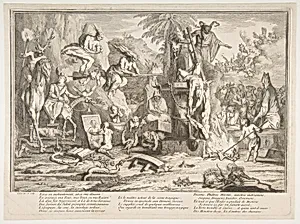
Est-ce un enchantment...
n.d.
Medium
Etching, third state
Dimensions
sheet: 10 3/16 x 13 11/16 in. (25.8 x 34.7 cm) image: 9 9/16 x 13 1/16 in. (24.3 x 33.2 cm)
Classification
Prints
Department
Drawings and Prints
Museum
Metropolitan Museum of Art, New York, NY
Credit
The Elisha Whittelsey Collection, The Elisha Whittelsey Fund, 1962
Accession Number
62.600.32
Rights
Public Domain
Tags
Art Historical Context
Claude Gillot’s etching *Est-ce un…* invites viewers into mysterious scene shaped by artist’s interest in the fantastical and the satirical. Created as a print in its third state, the work captures a moment of dramatic tension involving the devil, hell, and themes of punishment. Gillot, active in early eighteenth-century France and known for his lively drawings and etchings, often explored imaginative subjects that blurred the line between reality and illusion—perfectly echoed in the print’s questioning title. The medium of etching allowed Gillot to render intricate details with fine, expressive lines, giving the composition both energy and clarity. As a third state impression, this version reflects adjustments the artist made to refine tone and emphasis, a common practice that reveals the evolving dialogue between creator and plate. The result is a compact yet vivid image that feels both theatrical and moralizing, typical of the period’s fascination with the supernatural as a vehicle for social commentary. Housed in the Metropolitan Museum of Art’s Department of Drawings and Prints, this work offers today’s visitors a glimpse into the witty, sometimes dark visual culture of Gillot’s era. Its modest size belies the richness of its narrative, encouraging close looking and quiet reflection on the enduring power of images to enchant—or unsettle.
About the Artist
Claude Gillot · 1673–1722
Artist known for his elegant designs done in the Rococo manner of Audran; also for his predilection for scenes from the 'comedia dell'arte.' Few paintings survive; his work is known mainly through drawings and etchings. Comment on works: Genre; History