
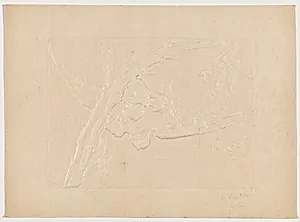
Le vautour (The Vulture)
Medium
cerograph (inkless embossment) on heavy japan paper
Dimensions
plate: 19.9 x 27.2 cm (7 13/16 x 10 11/16 in.) sheet: 28 x 38.1 cm (11 x 15 in.)
Classification
Department
CG-E
Museum
National Gallery of Art, Washington, D.C.
Credit
Virginia and Ira Jackson Collection, gift in memory of Virginia H. Jackson
Accession Number
1996.151.42
Rights
Public Domain
Art Historical Context
**Le Vautour (The Vulture)** Created in 1895 by French Aristide Rouseaud, *Le Vautour* is a striking print that captures the ominous form of a vulture through innovative technique rather than color. Produced during the fin-de-siècle era, when artists explored symbolism and the macabre, this work reflects the period's fascination with nature's darker aspects, evoking a sense of mystery and foreboding. The artwork's medium—cerograph, or inkless embossment heavy Japan paper—is particularly noteworthy. This rare printing method presses the design into the paper without ink, relying on raised relief lines and subtle shadows to define the image. Japan paper, prized for its durability and velvety texture, enhances the tactile drama, inviting viewers to appreciate the play of light across the embossed surface. Measuring 19.9 x 27.2 cm on the plate, it exemplifies late 19th-century experimentation in printmaking. Housed in the National Gallery of Art's Prints department (CG-E) as part of the Virginia and Ira Jackson Collection, *Le Vautour* highlights the artistry of embossed prints. Its gift in memory of Virginia H. Jackson underscores the enduring value of such technical marvels, offering visitors a tactile glimpse into an underappreciated facet of graphic innovation.