
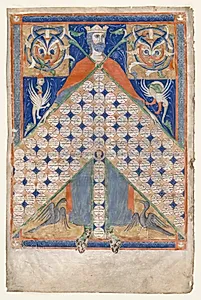
Leaf from Gratian's Decretum: Table of Consanguinity
Unknown Artist
c. 1270–1300
Medium
ink, tempera and gold on parchment
Dimensions
28.9 × 21.2 cm
Classification
Manuscript
Department
Medieval Art
Museum
Cleveland Museum of Art
Credit
Purchase from the J. H. Wade Fund
Accession Number
1929.435.2
Rights
Public Domain
About this artwork
These leaves were excised from a copy of the handbook of canon law known simply as the Decretum written by Gratian, an Italian Camaldolese monk, in Bologna around 1130–40. The Decretum was widely copied and consulted throughout the Middle Ages. Consanguinity diagrams were used to show the degree of kinship between an individual and his or her "blood" relations. These tables followed an established tradition dating back to around 600 CE. Until church law was relaxed in 1215, a marriage could only...