
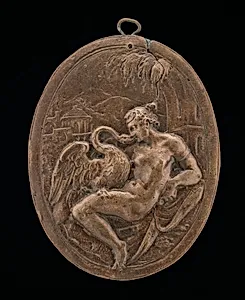
Leda and the Swan
early 17th century
Medium
bronze//Light red-brown patina
Dimensions
overall (oval, without loop): 6.1 x 4.8 cm (2 3/8 x 1 7/8 in.) gross weight: 26 gr
Classification
Sculpture
Department
CSD
Museum
National Gallery of Art, Washington, D.C.
Credit
Samuel H. Kress Collection
Accession Number
1957.14.586
Rights
Public Domain
Art Historical Context
This exquisite small bronze plaque by Paul Hübner portrays the timeless Greek myth of Leda and the Swan, in which Zeus, disguised as a swan, approaches the Spartan queen. Created in the early 17th century, the oval relief captures this dramatic encounter with graceful lines and subtle modeling, reflecting the period’s renewed interest in classical stories as vehicles for exploring themes of transformation and desire. Measuring just 6.1 by 4.8 centimeters and weighing only 26 grams, the work is cast in bronze with a warm light red-brown patina that enhances its tactile quality. The compact scale suggests it was intended as a collector’s piece or personal treasure, allowing viewers to hold and examine its fine details up close. Bronze’s durability and capacity for sharp relief made it ideal for such intimate objects during the transition from Renaissance to Baroque tastes. Hübner’s plaquette exemplifies the refined craftsmanship of early modern European sculptors who adapted monumental myths to miniature formats. Today it resides in the National Gallery of Art’s Samuel H. Kress Collection, inviting modern visitors to appreciate both the ancient legend and the delicate artistry of its telling.