
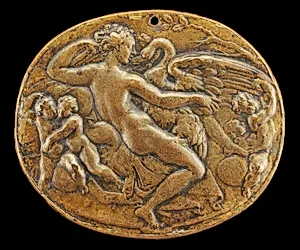
Leda and the Swan
16th century
Medium
bronze
Dimensions
overall (oval): 5.7 x 6.6 cm (2 1/4 x 2 5/8 in.) gross weight: 43 gr
Classification
Sculpture
Department
CSD
Museum
National Gallery of Art, Washington, D.C.
Credit
Widener Collection
Accession Number
1942.9.226
Rights
Public Domain
Art Historical Context
Nestled among the treasures of the National Gallery of's Widener Collection, this exquisite 16th-century Italian bronze, *Leda and the Swan*, captures a timeless mythological tale. Depicting the ancient Greek legend where Zeus, disguised as a swan, sed the Spartan queen Leda, the oval plaquette measures just 5.7 x 6.6 cm and weighs a delicate 43 grams. Such small-scale bronzes were prized Renaissance collectibles, often produced in workshops as affordable luxuries for scholars and nobles. Crafted in the High Renaissance era, the piece reflects Italy's fervent revival of classical antiquity. Artists drew inspiration from ancient myths and lost prototypes like Michelangelo's famous (now vanished) painting of the same subject, blending eroticism with graceful anatomy. The bronze medium allowed for intricate lost-wax casting, enabling fine details in feathers, flowing hair, and intertwined forms—techniques honed in foundries like those in Padua or Florence. This intimate sculpture invites contemplation of Renaissance humanism, where pagan stories celebrated beauty and desire. Its compact size belies its cultural weight, embodying the era's blend of artistry and scholarship, perfect for a visitor's quiet admiration.
About the Artist
Italian 16th Century · 1500–1599
"Italian 16th Century" refers to a collective attribution for anonymous painters and sculptors active in Italy during the 16th century, a period bridging the High Renaissance and Mannerism. These artists, often working in workshops of masters like Titian, Veronese, and Tintoretto, remain unidentified due to the collaborative nature of Renaissance production. Their early lives and training are not ...