
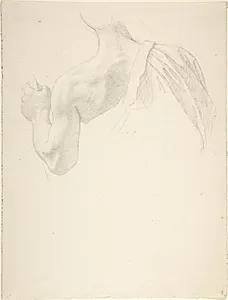
Left Arm and Shoulders of a Man Seen from the Back
early 19th century
Medium
Graphite
Dimensions
sheet: 10 3/8 x 7 7/8 in. (26.4 x 20 cm)
Classification
Drawings
Department
Drawings and Prints
Museum
Metropolitan Museum of Art, New York, NY
Credit
Purchase, Sotheby's Inc. Gift, 2008
Accession Number
2008.490
Rights
Public Domain
Tags
Art Historical Context
This delicate graphite drawing by Johann Friedrich Overbeck captures the subtle contours of a man’s left arm and shoulders viewed from behind. Created in the early nineteenth century, the work exemplifies Overbeck’s meticulous attention to anatomy and form. As a founding member of the Nazarene movement, Overbeck championed a return to the precise draftsmanship and spiritual depth of early Renaissance masters, rejecting the prevailing neoclassical style of his time. Rendered on a modest sheet measuring roughly ten by eight inches, the study highlights graphite’s capacity for soft shading and crisp line work. Such drawings often served as preparatory exercises for larger paintings, allowing artists to explore the play of light across musculature and fabric. Overbeck’s focus on the human figure reflects the Nazarenes’ belief that careful observation of nature could convey moral and religious ideals. Acquired by the Metropolitan Museum of Art in 2008, this intimate sketch offers visitors a glimpse into the quiet, disciplined process behind Overbeck’s more ambitious compositions. It reminds us that even the smallest studies can reveal an artist’s deep commitment to both technical mastery and heartfelt expression.
About the Artist
Johann Friedrich Overbeck · 1789–1869
**Johann Friedrich Overbeck** (3 July 1789 – 12 November 1869) was a German painter and a founder of the Nazarene movement. Born in Lübeck into a prominent Protestant family—his father, Christian Adolph Overbeck, was a doctor of law, poet, mystic pietist, and burgomaster—he received early classical and artistic instruction at the local Gymnasium under his uncle. Overbeck left Lübeck in 1806 to st...