
Left Greave and Sabaton
1540/50
Medium
Steel and gilding
Dimensions
H: 81.3 cm (32 in.) Wt: 2.5 lb.
Classification
arms and armor
Department
Applied Arts of Europe
Museum
Art Institute of Chicago
Accession Number
116641
Rights
Public Domain
About this artwork
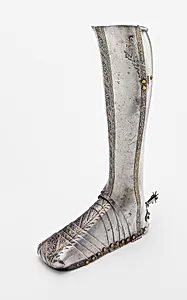
A fine example of the armor’s art, this sabaton (foot defense) follows period style in its broad, square toe. This piece is thought to have belonged to an armor made for the German duke William of Jülich-Cleves-Berg that now survives only in fragments scattered across several collections.
Art Historical Context
This elegant left greave and sabaton, crafted by the renowned German armorer Wolfgang Grosschedel around 1540–50, formed part of a suit of armor designed to protect the lower leg and foot. Measuring 81.3 centimeters in height and weighing just 2.5 pounds, the piece demonstrates the remarkable balance of strength and mobility achieved in Renaissance armor-making. Grosschedel, working in the courtly traditions of southern Germany, created armor for European nobility, where technical precision met artistic refinement. The medium of steel, enhanced with gilding, highlights both practical defense and luxurious display. The gilding would have caught the light during tournaments or ceremonial processions, signaling the wearer’s wealth and status. As part of the Applied Arts of Europe collection at the Art Institute of Chicago, this armor fragment reveals how 16th-century artisans transformed functional objects into works of art. Visitors can appreciate the subtle shaping that follows the natural contours of the leg, a hallmark of Grosschedel’s attention to both protection and elegance. Such pieces remind us that armor was not merely battlefield gear but a vital expression of identity and craftsmanship in Renaissance Europe.