
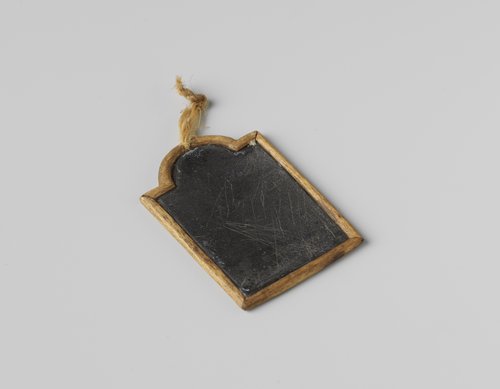
Leibord met houten rand
ca. 1700 - ca. 1799
Medium
slate (rock)
Dimensions
4.6; 0.2; 3.2
Rights
Public Domain
About this artwork
height 4.6 cm x width 3.2 cm x depth 0.2 cm
Art Historical Context
Nestled among our collection of everyday artifacts from the 18th century, *Leibord met houten* (Slate Board with Wooden Edge is a delicate anonymous creation dating to circa 1700–1799. Likely of Dutch origin—given the title's language—this petite object invites us to glimpse the intimate material culture of the era, when slate was prized for its smooth, writable surface and durability. Crafted from slate (a fine-grained metamorphic rock), the piece measures just 4.6 cm high, 3.2 cm wide, and 0.2 cm deep, framed by a wooden edge for protection and handling. Such miniature "leiborden" or slate boards were practical tools, possibly used as portable writing slates for children, merchants' notes, or personal memoranda. The thin profile and modest wooden border highlight humble craftsmanship, blending functionality with subtle artistry in an age before widespread paper affordability. Though unsigned, this artifact underscores the anonymous makers' ingenuity in everyday innovation. In a pre-industrial world, slate's reusability—wiped clean with a damp cloth—made it culturally vital for education and record-keeping, offering a tangible link to 18th-century daily life. A charming testament to overlooked vernacular art!
About the Artist
anonymous
In the vast tapestry of art history, "Anonymous" stands not as a singular individual but as a collective designation for countless unidentified creators whose works have endured across millennia. These artists, spanning prehistoric cave painters to medieval illuminators and folk craftsmen, produced the foundational layers of human visual culture. Prior to the Renaissance, when individual fame emer...