
Length of Woven Silk
Medium
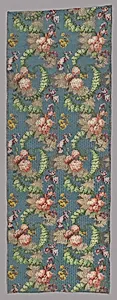
Silk, gilt-and-silvered-metal-strip- wrapped silk and silvered-metal strips, satin weave with brocading wefts and self-patterning plain interlacings of secondary binding warps and ground wefts
Dimensions
150.5 × 54.7 cm (59 1/4 × 21 1/2 in.); Repeat: 38.5 × 26.8 cm (15 1/8 × 10 1/2 in.)
Classification
weaving
Department
Textiles
Museum
Art Institute of Chicago
Accession Number
68853
Rights
Public Domain
About this artwork
In the 1730s a French designer named Jean Revel invented a technique for creating color shading in woven textile designs. This allowed for an increased appearance of volume in the depicted objects, such as the flowers, fruits, and leaves in this example.
Art Historical Context
This exquisite *Length of Woven Silk created in the style of Jeaniste Pillement around 1735–45, exemplifies the lavish Rococo aesthetic of mid-18th-century France Pillement, a renowned painter and designer, was celebrated for his intricate floral motifs, scrolling vines, and playful natural forms that influenced textile workshops across Europe. Though not directly attributed to his hand, this piece captures his signature whimsy, likely intended as a repeating pattern for opulent garments, draperies, or upholstery in aristocratic homes. Crafted from silk with gilt- and silvered-metal-strip-wrapped threads, the fabric employs a sophisticated satin weave enhanced by brocading wefts and self-patterning interlacings of secondary binding warps and ground wefts. This complex technique creates a shimmering, reflective surface with a 38.5 × 26.8 cm repeat unit, where metallic accents catch the light to mimic the era's love for extravagance and movement. Measuring 150.5 × 54.7 cm, it showcases the technical mastery of Lyonnaise or Parisian weavers, who blended luxury materials to evoke wealth and refinement. In the Art Institute of Chicago's Textiles collection, this weaving highlights the cultural zenith of French silk production, a cornerstone of Versailles-era fashion and diplomacy. Visitors can appreciate how such fabrics draped the elite, symbolizing taste and status in the opulent world of Louis XV.