
Lenz
1925
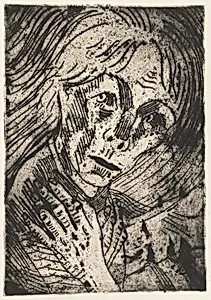
Medium
bound volume with 12 illustrations containing etching, drypoint, spitbite, and plate tone on laid Van Gelder-Bûtten paper
Dimensions
book: 47.2 × 33.3 × 1.7 cm (18 9/16 × 13 1/8 × 11/16 in.)
Classification
Volume
Department
CG-W
Museum
National Gallery of Art, Washington, D.C.
Credit
Gift of Ruth Cole Kainen
Accession Number
2012.92.261.7
Rights
Public Domain
Art Historical Context
**Lenz** (1925) by Walteratté is a captivating bound volume featuring 12 original illustrations that bring to life Georg Büchner's novella about the tormented poet Jakob Michael Reinhold Lenz. Created during the vibrant Weimar era, this artist book exemplifies Gramatté's Expressionist style, marked by intense, mystical visions and emotional depth. The German-born artist's prints evoke the story's themes of madness and nature's sublime power, blending psychological insight with raw, otherworldly imagery. Gramatté masterfully employed intaglio techniques—etching for precise lines, drypoint for velvety burrs, spitbite aquatint for soft, atmospheric veils created by saliva-mixed acid, and plate tone for subtle gradations—on luxurious laid Van Gelder-Bûtten paper. These methods allowed for rich tonal contrasts and textural drama, hallmarks of early 20th-century printmaking innovation. Measuring 47.2 × 33.3 × 1.7 cm, the volume's intimate scale invites close contemplation. A generous gift of Ruth Cole Kainen to the National Gallery of Art (Department CG-W, Classification: Volume), **Lenz** highlights Gramatté's brief but brilliant career, cut short by his death in 1929. It stands as a testament to the fusion of literature and visual art in modernist Europe, offering visitors a window into Expressionism's profound emotional resonance.
About the Artist
Walter Gramatté · 1897–1929
Walter Gramatté, born Walter Eduard Gramatté on January 8, 1897, in Berlin-Wedding to building manager Otto Gramatté and his wife Katharina, emerged as a poignant voice in German Expressionism despite a tragically brief career. The son of modest parents—described variably as a baker in some accounts—Gramatté volunteered for World War I in 1914 but was largely spared frontline duty due to chronic p...