
Lenz
1925
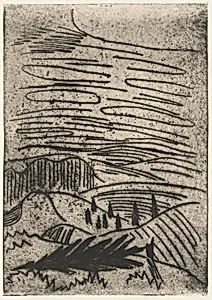
Medium
bound volume with 12 illustrations containing etching, drypoint, spitbite, and plate tone on laid Van Gelder-Bûtten paper
Dimensions
book: 47.2 × 33.3 × 1.7 cm (18 9/16 × 13 1/8 × 11/16 in.)
Classification
Volume
Department
CG-W
Museum
National Gallery of Art, Washington, D.C.
Credit
Gift of Ruth Cole Kainen
Accession Number
2012.92.261.12
Rights
Public Domain
Art Historical Context
**Lenz** is a captivating bound volume created by German Expressionist artist Walter Gramatté in 1925. This exquisite artist's book features 12 original illustrations that vividly interpret the themes of Georg Büchner's novella *enz*, a haunting tale of a poet's descent into madness the Storm and Stress literary movement. Gramatté, known for his and introspective style influenced by Expressionism, produced this work amid the turbulent Weimar Republic era, blending literary narrative with his profound graphic prowess before his untimely death in 1929. The technical mastery shines through Gramatté's innovative printmaking techniques: etching for precise lines, drypoint for rich, velvety burrs, spitbite—a daring method using saliva-mixed acid for soft, organic edges—and plate tone for atmospheric depth. Printed on high-quality laid Van Gelder-Bûtten paper from Holland, renowned for its texture and durability, the volume measures 47.2 × 33.3 × 1.7 cm, making it a tactile treasure for close study. Generously gifted to the National Gallery of Art by Ruth Cole Kainen, *Lenz* exemplifies early 20th-century book arts, bridging literature and visual expression. Visitors will appreciate how Gramatté's dark, emotive visions capture the novella's psychological intensity, offering a window into interwar artistic experimentation.
About the Artist
Walter Gramatté · 1897–1929
Walter Gramatté, born Walter Eduard Gramatté on January 8, 1897, in Berlin-Wedding to building manager Otto Gramatté and his wife Katharina, emerged as a poignant voice in German Expressionism despite a tragically brief career. The son of modest parents—described variably as a baker in some accounts—Gramatté volunteered for World War I in 1914 but was largely spared frontline duty due to chronic p...