
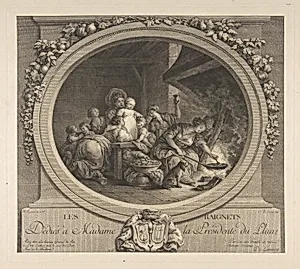
Les Beignets
Medium
Etching, third state
Dimensions
sheet: 14 7/8 x 21 5/16 in. (37.8 x 54.2 cm) image: 10 1/2 x 11 7/8 in. (26.7 x 30.1 cm)
Classification
Prints
Department
Drawings and Prints
Museum
Metropolitan Museum of Art, New York, NY
Credit
Purchase, Roland L. Redmond Gift, Louis V. Bell and Rogers Funds, 1972
Accession Number
1972.539.13
Rights
Public Domain
Tags
Art Historical Context
"Les Beignets" captures a lively domestic scene from eighteenth-century France, where women prepare fritters amid children and playful dogs. Created as an etching after a design by Jean-Honoré Fragonard, one of the leading figures of the Rococo movement, the print was executed by engraver Nicolas de Launay. Fragonard’s characteristically light and graceful style is preserved in this reproductive print, which celebrates everyday pleasures and the warmth of ordinary life rather than grand historical subjects. Etchings like this one played an important role in disseminating art beyond elite circles. As the third state of the plate, the work shows the refinements printmakers made to achieve greater tonal subtlety and detail. The medium allowed Fragonard’s joyful compositions to reach a wider audience through affordable reproductions, reflecting the period’s growing interest in genre scenes that blended charm with subtle social observation. Acquired by the Metropolitan Museum of Art in 1972, this impression highlights the enduring appeal of Rococo imagery. Its focus on food, labor, and family offers modern viewers a delightful glimpse into the textures of eighteenth-century French daily life.
About the Artist
Jean Honoré Fragonard|Nicolas de Launay · 1732–1806
Jean-Honoré Fragonard (1732-1806) was a French painter and printmaker whose late Rococo manner was distinguished by remarkable facility, exuberance, and hedonism. Born in Grasse, he moved to Paris where he trained under Jean-Baptiste Chardin and François Boucher, winning the prestigious Prix de Rome in 1752. After studying in Italy alongside Hubert Robert, Fragonard returned to Paris in 1761 to fi...