
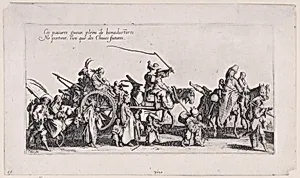
Les Bohémiens en Marche: L'Arrière-Garde, pièce aussi appelée Le Départ (The Gypsies Travelling: The Rear Guard, also called The Departure), from Le Bohémiens, série appelée aussi Les Égyptiens, La Marche des Bohémiens, La Vie Errante des Bohémiens, Les Marches Égyptiennes (The Gypsies, series also called The Egyptiens, The Gypsy Troops, The Wandering Lives of Gypsies, The Egyptian Troops)
early 17th century
Medium
Etching and engraving; second state of four (Lieure)
Dimensions
Sheet: 10 3/8 x 10 15/16 in. (26.4 x 27.8 cm) Plate: 8 7/8 x 9 7/16 in. (22.5 x 23.9 cm)
Classification
Prints
Department
Drawings and Prints
Museum
Metropolitan Museum of Art, New York, NY
Credit
Rogers Fund, 1922
Accession Number
22.67.47
Rights
Public Domain
Art Historical Context
Jacques Callot's *Les Bohémiens en Marche L'Arrière-Garde (The Gypsies Travelling: Rear Guard, also calledThe Departure*), from his early 17th-century *Les Bohémiens* (also known as *The Egyptiens* or *The Gypsy Troops*), captures the chaos of a wandering Roma procession. This etching and engraving depicts the straggling rear guard—families, animals, and carts trudging along—evoking the nomadic "wandering lives" that fascinated European artists of the Baroque era. Callot, a masterful French printmaker, drew from his travels in Italy and Lorraine, infusing the scene with lively, anecdotal detail amid the region's social upheavals like the Thirty Years' War. Renowned for his innovative etching techniques, Callot achieved extraordinary density of figures in a compact plate (8 7/8 x 9 7/16 in.), using fine, wiry lines to convey movement and individuality. This second state of four, enhanced with additional engraving for richer tone, exemplifies his rococo precursors' precision, influencing later genre scenes by artists like Rembrandt. Produced around 1628-1630, the series reflects 17th-century curiosity about "exotic" outsiders, blending empathy with exoticism. Now in the Metropolitan Museum of Art (Rogers Fund, 1922), this print invites visitors to ponder the lives of Europe's marginalized travelers through Callot's unflinching gaze, a testament to printmaking's power to democratize art.
About the Artist
Jacques Callot · 1592–1635
Jacques Callot (1592–1635) was a French printmaker and draftsman from the Duchy of Lorraine, widely regarded as one of the first great artists to practice the graphic arts exclusively. His more than 1,400 etchings chronicled the breadth of 17th-century life, from Medici court festivities to the brutal realities of warfare. Callot revolutionized etching through technical innovations including the é...