
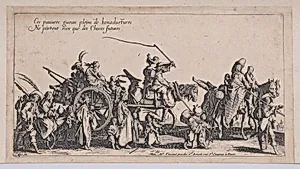
Les Bohémiens en Marche: L'Arrière-Garde, pièce aussi appelée Le Départ (The Gypsies Travelling: The Rear Guard, also called The Departure), from Le Bohémiens, série appelée aussi Les Égyptiens, La Marche des Bohémiens, La Vie Errante des Bohémiens, Les Marches Égyptiennes (The Gypsies, series also called The Egyptiens, The Gypsy Troops, The Wandering Lives of Gypsies, The Egyptian Troops)
early 17th century
Medium
Etching and engraving; fourth state of four [?] (Lieure)
Dimensions
Mount: 5 13/16 x 11 1/16 in. (14.8 x 28.1 cm) Sheet: 5 5/16 x 9 13/16 in. (13.5 x 24.9 cm) Plate: 4 15/16 x 9 5/16 in. (12.6 x 23.7 cm)
Classification
Prints
Department
Drawings and Prints
Museum
Metropolitan Museum of Art, New York, NY
Credit
Gift of Harry G. Friedman, 1962
Accession Number
62.635.585
Rights
Public Domain
Art Historical Context
Jacques Callot's *Les Bohémiens Marche: L'Arrièrearde* (The Gypsies Travelling: The Guard, also called *The Departure*), from the early 17th, captures the vibrant energy of a Romani caravan in motion. Part of Callot's renowned *Le Bohémiens* series—also known as *Lesgyptiens* or *La Marche des Bohémi*—this etching and engraving depicts the straggling rear guard of a wandering troupe, blending everyday life with a sense of nomadic romance. Created during Callot's prolific career in the Baroque era, the print reflects his fascination with marginalized communities, often portrayed with empathy and intricate detail amid the courts of Florence and Lorraine. A master of printmaking, Callot combined etching's fluid lines with engraving's precision to populate tiny sheets—here, just 4 15/16 x 9 5/16 inches—with dozens of figures, animals, and wagons. This fourth state of four, as cataloged by Lieure, represents the fully realized version, showcasing his innovative technique for mass-producing high-quality images that influenced generations of artists. Housed in the Metropolitan Museum of Art's Drawings and Prints department (gift of Harry G. Friedman, 1962), the work offers a window into 17th-century perceptions of "Bohemians" or "Egyptians"—terms for Roma people—evoking their itinerant lives against a backdrop of European social hierarchies. It's a testament to Callot's ability to elevate the ordinary into the extraordinary.
About the Artist
Jacques Callot · 1592–1635
Jacques Callot (1592–1635) was a French printmaker and draftsman from the Duchy of Lorraine, widely regarded as one of the first great artists to practice the graphic arts exclusively. His more than 1,400 etchings chronicled the breadth of 17th-century life, from Medici court festivities to the brutal realities of warfare. Callot revolutionized etching through technical innovations including the é...