
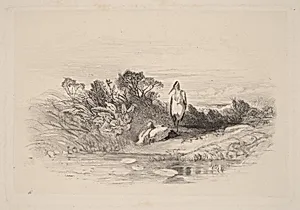
Les Deux Herons
1801 to 1825
Medium
etching
Classification
Department
CG-E
Museum
National Gallery of Art, Washington, D.C.
Credit
Rosenwald Collection
Accession Number
1950.16.3
Rights
Public Domain
Art Historical Context
"Les Deux Herons" is a delicate etching created by Swiss-born artist Karl Bodmer between 1801 and 1825. The work captures two herons with graceful precision, reflecting the era’s growing fascination with natural history and detailed observation of wildlife. Bodmer, who later gained renown for his ethnographic illustrations of Native American life, here demonstrates an early command of printmaking that would define much of his career. As an etching, the print highlights the medium’s ability to render fine lines and subtle textures through the careful biting of acid into a metal plate. This technique allowed artists to reproduce intricate natural forms with remarkable clarity, making such works widely accessible beyond the original drawing. The piece’s presence in the National Gallery of Art’s Rosenwald Collection underscores its value as an example of early nineteenth-century European printmaking at a time when scientific interest in birds and nature was flourishing.
About the Artist
Karl Bodmer · 1809–1893
Johann Carl Bodmer was born on February 11, 1809, in Zürich, Switzerland, and received his training as a painter and engraver under his uncle Johann Jakob Meier, who had himself studied under the prominent engraver Heinrich Füssli. By the late 1820s Bodmer had relocated to Koblenz, Germany, where his work came to the attention of Prince Maximilian zu Wied-Neuwied, a German naturalist-explorer plan...