
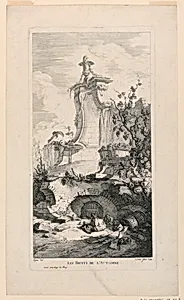
Les Fruits de L'Automne
ca. 1735-1740
Medium
Classification
Department
Smithsonian Collection
Museum
Smithsonian American Art Museum
Credit
Purchased for the Museum by the Advisory Council
Accession Number
1921-6-192
Rights
Public Domain
About this artwork
Research in Progress
Art Historical Context
**Les Fruits de L'Automne** (The Fruits of Autumn), created around 1735-1740 by French engraver Charles-Nicolas Cochin the Elder (1688–1754), captures the bountiful harvest themes so cherished in 18th-century Europe. As a delicate print, it likely showcases an array of seasonal produce—apples, grapes, and gourds—arranged in the ornate, playful style of the Rococo movement. Cochin, a master engraver known for his intricate book illustrations and decorative designs, excelled in translating opulent compositions into reproducible prints, making fine art accessible beyond elite circles. This work reflects the cultural fascination with nature's cycles during Louis XV's reign, when abundance symbolized prosperity and delight. Rococo prints like this one adorned homes and portfolios, blending realism with whimsical elegance through Cochin's precise etching techniques, which allowed for rich textures and subtle shading. Housed in the Smithsonian American Art Museum's collection—purchased by the Advisory Council—it highlights transatlantic exchanges of European artistry. Though research continues, **Les Fruits de L'Automne** invites us to savor autumn's generosity, evoking the sensory joys of a bygone era's feasts. (178 words)