
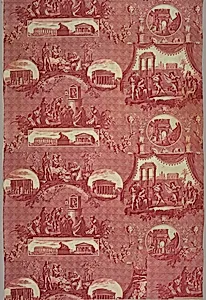
Les monuments de Roma
Classification
printed, dyed & painted textiles
Department
Smithsonian Collection
Museum
Smithsonian American Art Museum
Credit
Bequest of Elinor Merrell
Accession Number
1995-50-64
Rights
Public Domain
About this artwork
Research in Progress
Art Historical Context
Jean-Baptiste Huët, a French painter and textile designer active during the late eighteenth and early nineteenth centuries, created "Les monuments de Roma" in the final year of his life. Best known for his work with the Manufacture Royale de Jouy, Huët specialized in producing detailed printed cottons that brought narrative scenes into domestic settings. This textile, now part of the Smithsonian American Art Museum’s collection, carries the evocative title “The Monuments of Rome,” suggesting a celebration of classical architecture through the medium of fabric. Classified as printed, dyed, and painted textiles, the work reflects the technical advances of its time, when engraved copper plates allowed complex, repeatable images to be transferred onto cloth. Created in 1811 amid Europe’s ongoing fascination with antiquity—fueled by archaeological discoveries and neoclassical taste—the piece would have offered viewers an accessible encounter with Rome’s storied landmarks within their own homes. Bequeathed by collector Elinor Merrell, "Les monuments de Roma" exemplifies how Huët transformed grand historical subjects into intimate, functional art. Its presence in an American museum today highlights the enduring transatlantic appreciation for these finely crafted textiles.