
Les Monuments Romains
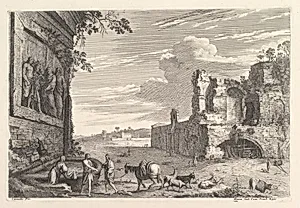
Medium
Etching
Dimensions
sheet: 11 5/8 x 17 13/16 in. (29.5 x 45.3 cm) image: 8 5/16 x 12 3/8 in. (21.1 x 31.5 cm)
Classification
Prints
Department
Drawings and Prints
Museum
Metropolitan Museum of Art, New York, NY
Credit
Harris Brisbane Dick Fund, 1945
Accession Number
45.35.18
Rights
Public Domain
Tags
Art Historical Context
"Les Monuments Romains" a captivating etching attributed to French engraver Jean after a composition by Dutch Golden Age artist Cornelis van Poburch. Created in the 17th century—though the exact date remains unknown—this print measures 11 5/8 x 17 13/16 inches on its sheet and captures the allure of ancient Roman ruins, populated by men, women, and animals Housed in the Metropolitan Museum of Art's Drawings and Prints department, entered the collection via the Harris Brisbane Dick Fund in 1945. Van Poelenburch, renowned for his small-scale Italianate landscapes, often depicted classical ruins as poignant reminders of time's passage, blending meticulous detail with atmospheric light. Morin, a skilled reproductive printmaker, translated this vision into etching—a technique that allowed for intricate lines and tonal depth, making such grand scenes accessible beyond original paintings. The work reflects the era's growing fascination with antiquity during the Dutch Golden Age, when artists drew inspiration from Roman heritage amid Europe's cultural revival. This piece invites visitors to ponder the interplay of human life amid decaying monuments, evoking themes of impermanence and wonder. A testament to collaborative artistry, it showcases how prints democratized fine art, bridging Northern European precision with classical grandeur.
About the Artist
Jean Morin|Cornelis van Poelenburch · 1605–1650
Jean Morin (c. 1605–1650) was one of the most accomplished French engravers of the seventeenth century, a master of the portrait print whose work stands among the finest examples of French graphic art in its era. Little is known about his early life or training, though his technique suggests exposure to both French and Flemish engraving traditions, the latter being the dominant force in European p...