
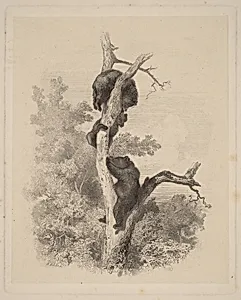
Les Ours (The Bears)
1858/1874
Medium
etching in black on chine collé
Dimensions
sheet: 21.6 x 17.6 cm (8 1/2 x 6 15/16 in.) support: 38 x 26.4 cm (14 15/16 x 10 3/8 in.)
Classification
Department
CG-E
Museum
National Gallery of Art, Washington, D.C.
Credit
René Huyghe Collection
Accession Number
1994.42.2
Rights
Public Domain
Art Historical Context
Karl Bodmer’s *Les Ours (The Bears)* is a striking example of nineteenth-century printmaking, created between 1858 and 1874. A Swiss-French artist celebrated for his precise depictions of natural subjects, Bodmer employed the etching technique to capture the texture and presence of his animal subjects with remarkable clarity. The work’s intimate scale invites close viewing, allowing the fine lines of the etching to convey both the bears’ physical power and their quiet vitality. Printed in black on chine collé, the etching rests on a delicate sheet of Asian paper mounted to a larger support. This refined method, popular among European printmakers of the period, enhances tonal depth and preserves the crisp detail of each etched line. The resulting image bridges scientific observation and artistic expression, reflecting the era’s growing fascination with natural history and wildlife illustration. Part of the René Huyghe Collection at the National Gallery of Art, *Les Ours* exemplifies how prints served as accessible yet sophisticated vehicles for artistic ideas. Its modest dimensions belie the technical mastery and enduring appeal of Bodmer’s work, offering viewers a window into both the animals depicted and the rich traditions of nineteenth-century etching.
About the Artist
Karl Bodmer · 1809–1893
Johann Carl Bodmer was born on February 11, 1809, in Zürich, Switzerland, and received his training as a painter and engraver under his uncle Johann Jakob Meier, who had himself studied under the prominent engraver Heinrich Füssli. By the late 1820s Bodmer had relocated to Koblenz, Germany, where his work came to the attention of Prince Maximilian zu Wied-Neuwied, a German naturalist-explorer plan...