
Les Propos de Thomas Vireloque: The old story, my lambkins
1852
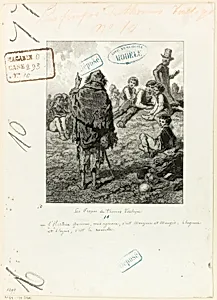
Medium
Lithograph in black on cream wove paper
Dimensions
Image: 19 × 16 cm (7 1/2 × 6 5/16 in.); Sheet: 34.4 × 24.7 cm (13 9/16 × 9 3/4 in.)
Classification
lithograph
Department
Prints and Drawings
Museum
Art Institute of Chicago
Accession Number
10993
Rights
Public Domain
Art Historical Context
Paul Gavarni's *Les Propos de Thomas Vloque: The old, my lambkins* (1852) is a charming lithograph capturing the wit and whimsy of mid-19th-century French culture. Created in black ink on cream wove paper, the intimate image measures just 19 × 16 cm, while the full sheet spans 34.4 × 24.7 cm—perfect for affordable reproduction and display in Parisian homes or journals. Housed in the Art Institute of Chicago's Prints Drawings Department, this piece exemplifies Gavarni's mastery lithography, a technique he helped popularize for its fluid lines and tonal subtlety, allowing artists to mimic drawing with remarkable precision. Gavarni, a leading caricaturist of the Romantic era, often depicted everyday Parisian life with satirical flair, contributing to publications like *Le Charivari*. This work belongs to his *Les Propos de Thomas Vireloque* series, featuring the fictional folksy character delivering proverbial wisdom in humorous vignettes. The title's playful English translation ("The old story, my lambkins") hints at a lighthearted moral tale, reflecting the era's fascination with illustrated proverbs amid France's Second Empire social shifts. Lithographs like this democratized art, bridging high culture and the masses, and offer a window into 1850s humor and language. A delightful gem for visitors, it reminds us how prints preserved the vivacity of spoken traditions.
About the Artist
Paul Gavarni · 1804–1866
Paul Gavarni, born Sulpice Guillaume Chevalier on January 13, 1804, in Paris to a cooper father from Burgundy and mother Marie-Monique Thiémet—whose brother, painter Guillaume Thiémet, served as his godfather—began his career far from the art world. As a youth, he worked in a machine factory and studied mechanical drawing at the Conservatoire des Arts et Métiers in 1818, followed by evening classe...