
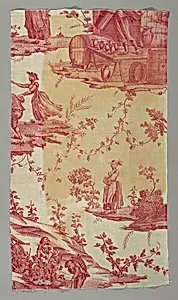
Les Vendanges
Classification
printed, dyed & painted textiles
Department
Smithsonian Collection
Museum
Smithsonian American Art Museum
Credit
Smithsonian American Art Museum
Accession Number
1952-80-5-d
Rights
Public Domain
About this artwork
Research in Progress
Art Historical Context
**Les Vendanges** (*The Grape Harvest*), created by French artist Jean-Baptiste Huet in 1785, captures the joyful spirit of rural France during the late Rococo era. Huet (1745–1811), renowned for his idyllic pastoral scenes filled with lively figures, animals, and lush landscapes, often drew inspiration from everyday countryside festivities. This artwork, classified as a printed, dyed, and painted textile, depicts harvesters amid vines, evoking abundance and communal celebration—a common motif in 18th-century decorative arts. As a textile piece from the Smithsonian American Art Museum's collection, *Les Vendanges* highlights the artistry of printed fabrics, a technique blending printing, dyeing, and hand-painting for vibrant, durable designs. These textiles adorned homes and public spaces, bridging fine art with everyday luxury. Huet's style, with its playful Rococo elegance and attention to nature's rhythms, made him a favorite for manufactories like Beauvais, influencing fashion and interiors on both sides of the Atlantic. Dated just four years before the French Revolution, the scene reflects a nostalgic view of pre-industrial harmony, offering visitors a window into Enlightenment-era escapism. Though research continues, its presence in the Smithsonian underscores the global appeal of French textile innovation.